Delivered by: Matt Collins MPIA, PIA CEO
As you will have seen, this year marks your Institute’s 75th anniversary.
And it is especially fitting that we are here in Canberra today.
Because 75 years ago, in 1951, the Planning Institute of Australia was founded just across the lake at Albert Hall.
Planners look a little different - and a lot more diverse - today.
And from that gathering at Albert Hall to this Congress in 2026, generations of planners have come together through this Institute to help shape Australia’s cities, towns, regions and communities.
This is National Volunteers Week, and I want to acknowledge our PIA Fellows, Life Fellows, Honorary Fellows, Presidents, Board Directors, and the many members and volunteers - past and present - who have contributed their time, expertise and leadership to strengthen this Institute and advance the profession across Australia.
PIA is only here today because so many planners have chosen to contribute: to mentor others, to lead conversations, to advocate for planning and to help build a stronger professional community.
That contribution deserves our recognition and thanks.
I’d also like to take a moment to acknowledge that PIA National President Emma Riley is unfortunately unable to join us this week due to a bereavement in her family. Emma asked me to pass on her very best wishes for a productive, engaging and successful Congress, and I know the thoughts of the PIA community are with her and her family.
I’d also like to acknowledge and welcome several international guests joining us here in Canberra.
In particular, I would like to acknowledge:
-
Sue Schwartz, President of the American Planning Association
-
Joel Albizo, CEO of the American Planning Association
-
Andrea Harris, Chair of the New Zealand Planning Institute
-
David Curtis, CEO of the New Zealand Planning Institute
-
Rebecca Wong, Vice-President of the Hong Kong Institute of Planners
-
Muhammad Ariful Islam, President of the Bangladesh Institute of Planners
Your presence here reflects the strong connections between our institutes and the shared challenges and opportunities facing planners globally. We are delighted to have you with us for Congress 2026.
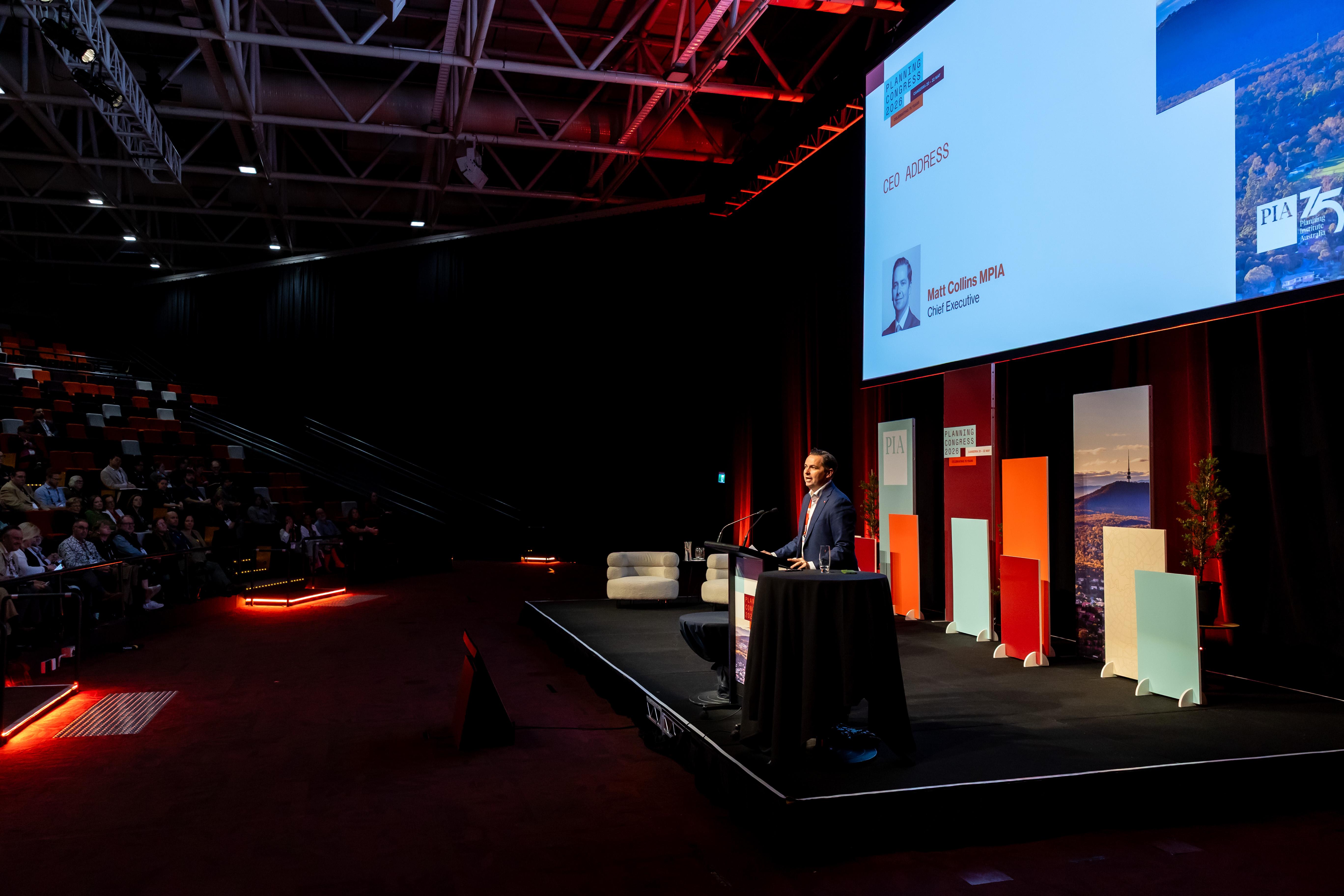
As we mark PIA’s 75th, milestones like this are not only a chance to look back. They are also a chance to look ahead and ask ourselves:
What kind of profession do we need to be for the future?
Because planning today is operating in an environment that is more complex, more contested and changing more rapidly than at any point in recent memory.
Across Australia, our communities are grappling with the housing affordability crisis, infrastructure demands, climate impacts, population growth, changing technologies and increasing expectations about the places people live and work.
Planning systems are under pressure.
Planners are under pressure.
And debates about growth, development and change have become louder and more polarised.
But the challenges facing planners today are not only technical or procedural.
They are also environmental. Economic. Social. Political.
And they are deeply connected to the way we think about people, place and planet.
That’s why it feels so fitting that we have begun Congress this morning by reflecting on Country-centred planning and the importance of understanding connection and long-term stewardship in the work we do.
Because the idea of planning with Country challenges us to think beyond planning as simply a system of rules and approvals, and instead consider planning as stewardship… for communities, for Country and for future generations.
I think that conversation is incredibly important for our profession as we look ahead.
And just now, we have heard from Minister O’Neil, who spoke about the immense national and intergenerational challenges Australia is facing - particularly around housing, growth and how we meet the moment.
Those challenges are real.
And they are significant.
But these pressures don’t reduce the importance of planning.
They reinforce why planning matters now, more than ever.
And I don’t mean the rules and regulations, but rather the work of planners and planning.
Because when communities are growing quickly…
when infrastructure decisions have consequences lasting generations…
when climate resilience becomes more urgent…
when governments are trying to balance housing supply, productivity, liveability and sustainability…
the need for thoughtful and future-focused planning only becomes greater.
Good communities don’t happen by accident.
The places people value most… the neighbourhoods, parks, public spaces and communities people are proud to call home… they’re the result of planning.
And behind that work are planners.
The people in this room.
You.
People who work every day across the country in the public interest – whether that be for governments, consultancies, universities, community organisations or industry; often in challenging environments and under competing expectations.
Planning is not easy work, but it is essential.
It involves balancing trade-offs.
Navigating competing interests.
Thinking beyond immediate pressures.
And making decisions that will shape communities long after today’s debates have passed.
That responsibility matters.
And I think it is important to say clearly to everyone here today: the work you do is vital.
Not just to individual projects or policies, but to our nation’s future.
Planners help communities navigate change.
We help governments understand consequences and trade-offs.
We help align housing with infrastructure, transport, environment and community outcomes.
And increasingly, we help communities think about the long term in a world that often rewards the short-term.
That role has never been more important.
As we reflect on PIA’s 75 years, we should be proud of the contribution this profession has made to Australia.
But we should also recognise that the future will demand more from planners than ever before.
Many of our planning systems were designed for a different era.
An era before climate adaptation became central to city-making.
Before rapid technological disruption.
Before heightened community expectations.
Before the scale of today’s housing pressures.
Before governments were simultaneously trying to deliver growth, productivity, resilience and liveability at such scale and speed.
And increasingly, planners are being asked to respond to challenges that do not sit neatly within traditional boundaries.
Housing is connected to infrastructure.
Infrastructure is connected to climate resilience.
Climate resilience is connected to economic productivity.
And all of it is connected to the quality of life and cost of living people experience in their communities.
That means the future of planning cannot simply be about processing applications faster or managing individual developments.
The future of planning must be about helping communities navigate complexity and change more effectively.
So, a defining question for our profession over the coming decades is this:
Are our planning systems ready for the future challenges ahead? And if they’re not, how do we lead the change needed to make them work better?
Because planners are not simply participants in planning systems.
We are uniquely placed to help improve them.
We are the experts.
We understand where systems work well.
We understand where they struggle.
We understand the importance of coordination, implementation and long-term thinking.
And importantly, planners understand that good reform is not simply about faster decisions. It is about better outcomes.
That is why this moment matters for PIA as well.
For 75 years, PIA has been the professional home for planners across Australia.
A place for connection.
For professional standards.
For leadership.
For advocacy.
And for collective purpose.
And just as the profession must continue adapting to new challenges, PIA must continue evolving too.
Which brings me to today.
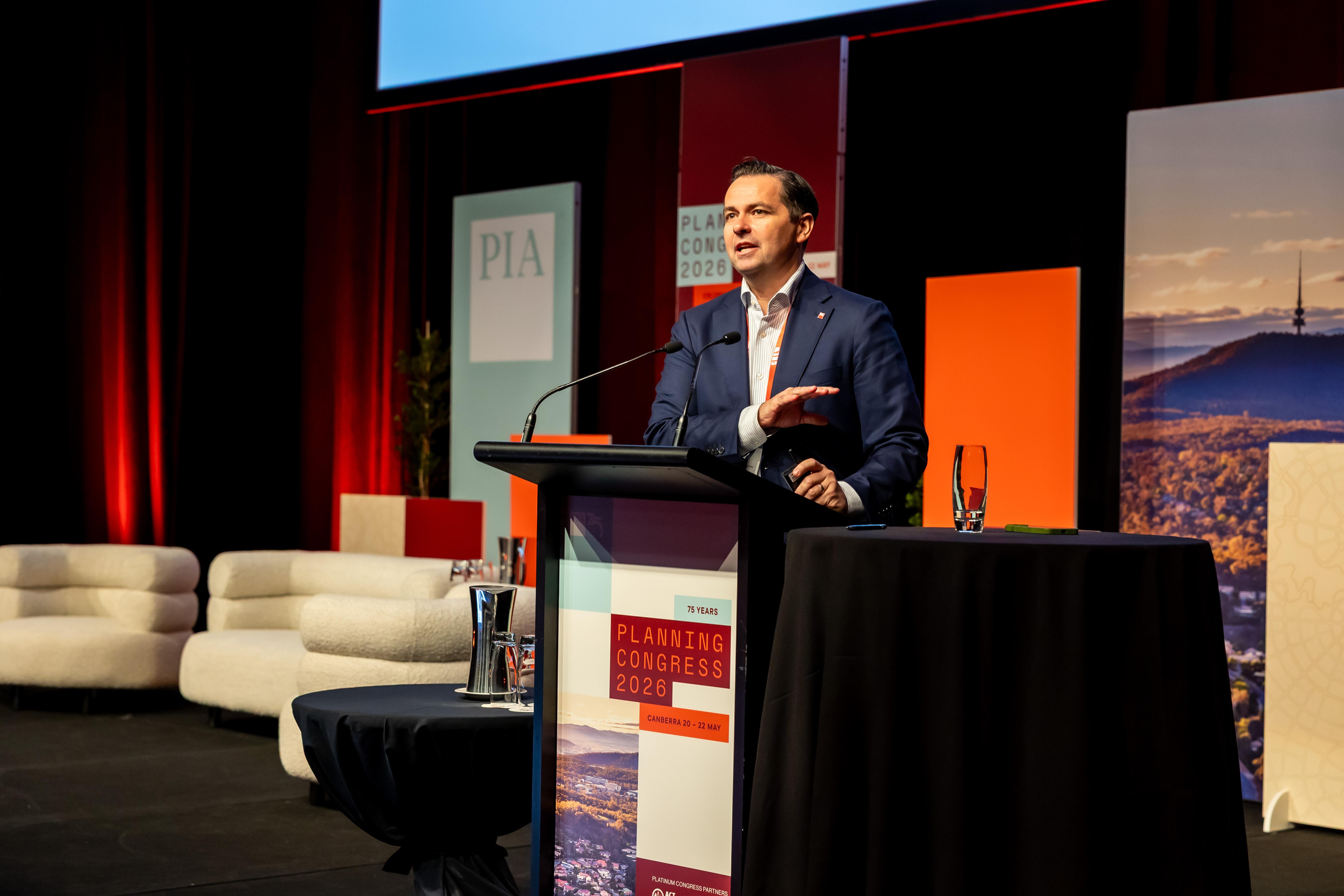
This morning, I am pleased to formally launch PIA2040, the new long-term strategic plan for your Institute, which was finalised by the Board last month.
PIA2040 is grounded in a simple but important belief: that planning has a critical role to play in shaping Australia’s future, and that planners deserve an effective and future-focused professional body standing with them.
This strategy is about strengthening PIA’s voice.
Supporting you throughout your careers.
Connecting the profession more deeply.
And ensuring planning remains central to the conversations shaping our communities.
PIA2040 is a commitment to continue strengthening PIA’s impact and supporting you more throughout your careers.
And as we look toward the next chapter for PIA and for the profession, I am optimistic.
Optimistic because of the capability, commitment and passion that exists across this profession.
Optimistic because planners continue to step forward to tackle increasingly complex challenges.
And optimistic because the need for good planning has never been greater.
The future will not shape itself.
And that is why planning, and planners, matter now more than ever.